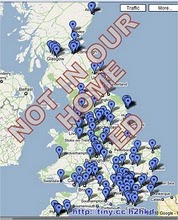
So Mr. Badman has noted the serious interest taken in his pseudo-intellectual recommendations and the furious pace of home educators who have brilliantly and effectively dismantled the edifice on which they stand (or totter).
He has had to shout for his pals in the LAs to come and help him as he sinks further into the mire upon which he set out his stall.
If you take a report so poorly written that becomes a platform upon which a government builds changes in the (already perfectly good) law, and in the report you use dodgy statistics, irrational proposals, hopeless illogic, and seek reckless destruction of laws that serve us well by providing a balance between the power of the state (local authorities) and the power of the people (parents), then you can expect to be questioned, have your work eyed up like a stripper's g-string, and thoroughly and roundly criticised.
That we allow a man who is so blatantly and obviously prejudiced to write such damning and completely inane and dangerous drivel is a strike against the heart of this country.
That he has the nerve (I nearly said balls!) to flail about like a drowning weasel to ask for more evidence to back up his insanity is another strike against the living tissue of this land.
That he is allowed more time to receive this help, to regroup his forces of darkness to continue this disgusting and evil power-play against law-abiding, caring parents is a thrust of the dagger down into the very soul of Britain.
So let's see how deep the rabbit hole goes. How many consultations? How many ultra vires LAs? How many happy children who home educate? How many home educators on the review panel?
How much money has been drained out of the coffers for this utter vile travesty? How many children are better off for this DCSF and its spin meisters?
Consultations? Four or five. Others that concern home educators. Too damn many. We actually have lives, you know.
Ultra vires LAs? Dozens? I have been a member of a few lists for four years and can recall agonised parents shouting for help so many times. My own LA representative lied to me about having the right to come into my house (but, cunningly, I had checked with a member of a national home education group so I knew that she had no right). She lied to me. A public servant, whose rations I help to pay for, brass-faced and staring me in the eyes, LIED to me.
Happy home educating children? I don't know an unhappy one, and have never heard of a child who doesn't unfold like a pinched plant leaving the darkness and reviving in the sun as they grow into home education.
Home educators on the review panel? None. Eh? Yes, none. The true experts. The non-school, home educating as I live and breath experts. Representation in Badman's group of bad advisors? Not one.
Tax payers' money? Well, my 88 year old mother probably contributed her share. The bill will add to about £275,000. Of course, this is a guess; informed by Tanya Byron's equally stupid review of computer games. We, who pay for these things, don't know the true total because the DCSF won't tell us. Telling us how much we've coughed up is a form of harassing and vilifying Badman apparently.
How many children are better off? None. In fact, they are worse off. Quite a few concerned mothers have told me that their children are terrified to see officials alone, don't want to be showing their work, don't want to perform for schooly agents like performing fleas, and are scared of the Badman.
They've cried themselves to sleep.
Cried. Children. Shed tears.
Some of them are petrified that they will be forced - frog-marched - back to school from which safe and glorious hell hole they had previously been removed because they were in danger.
Safeguarding?
Yeah, right.
Pull the other one.
Friday, 18 September 2009

Saturday, 12 September 2009
The blaming nation
Part of the problem with Badman reports and issues with anything is
a) problematising and
b) blaming
I'd like to take b) first. When I was emigrated to Canada - I say it that way because I had no choice - one of the first things I did was ask my Dad if he would buy me a bike. I had given my bike from home to a friend who could make good use of it. After our move to Canada, we were living in a fairly rural area; a few dirt tracks and some houses, near my Dad's cousin.
I got my bike. I went out on it. Confession: my biking skills were not that great. We had lived in a terrible place for the care and exercising of bikes. Lots of killer cars and a wobbly me who hadn't biked for long. Anyway, it was the summer so I forged up and down on my new shiny bike.
Then I hit a stone and went over, down on one knee. That hurt, but the humiliation hurt more than the bloody long graze.
What happened then?
Did I sit there and condemn the bike? No. I was not a good cyclist, but that wasn't the bike's fault.
Did I pulverise the stone into a million pieces for causing my fall? No, it wasn't the fault of the stone; it was just doing what stones will do and have done for centuries.
I didn't blame anyone or anything.
It was an accident.
They happen. They happen a lot. They happen to everyone.
So why do we blame the LA personnel for educational problems? Why do we run to the legal system to squeeze out money after someone has done something to us? It's because we blame other people. There is a strong tradition of blaming people or groups in this society.
Often seen headlines: "Politicians slammed for failure to..." or "The government was criticised for..."
I don't think the blame game is healthy and, often, it doesn't help at all. Blaming parents for educating their children when the alternative is an inadequate education - even in an inadequate place to be (have you seen some school buildings?) - at the hands of a state-sponsored system is not a sensible response. If your youngster were suffering from asbestos poisoning in a room, wouldn't you take him out of the room? It's the same principle. After all, unless you are completely turned around mentally, you do actually want the best for your offspring.
a) Problematising.
Problematising is making something a problem when it hasn't been a problem and it isn't a problem. Home education is not a problem. Schooling is. Home education is natural and unproblematic, has been happening since the dawning of recorded time and before that or we wouldn't have survived as a species. Schooling isn't natural and unproblematic and hasn't been around since the dawn of time. Problematising happens when a group of people - like politicians - haven't got enough to do and cannot do much about what they are supposed to do something about so they create a problem, and then they create another problem when they problematise what wasn't a problem in the first place. A politician creates problems because he wants to have solutions that he can measure to say to people "Look how well I'm doing my job. The problem (that I created) has been solved so I'm clever and creative at solving problems.' That's a vote winner. Or has been.
And you know what they say "If you're not part of the solution, you're part of the problem." Definitely you'll be part of the problem if you generated the problem in the first place.
Home education? No problem!
a) problematising and
b) blaming
I'd like to take b) first. When I was emigrated to Canada - I say it that way because I had no choice - one of the first things I did was ask my Dad if he would buy me a bike. I had given my bike from home to a friend who could make good use of it. After our move to Canada, we were living in a fairly rural area; a few dirt tracks and some houses, near my Dad's cousin.
I got my bike. I went out on it. Confession: my biking skills were not that great. We had lived in a terrible place for the care and exercising of bikes. Lots of killer cars and a wobbly me who hadn't biked for long. Anyway, it was the summer so I forged up and down on my new shiny bike.
Then I hit a stone and went over, down on one knee. That hurt, but the humiliation hurt more than the bloody long graze.
What happened then?
Did I sit there and condemn the bike? No. I was not a good cyclist, but that wasn't the bike's fault.
Did I pulverise the stone into a million pieces for causing my fall? No, it wasn't the fault of the stone; it was just doing what stones will do and have done for centuries.
I didn't blame anyone or anything.
It was an accident.
They happen. They happen a lot. They happen to everyone.
So why do we blame the LA personnel for educational problems? Why do we run to the legal system to squeeze out money after someone has done something to us? It's because we blame other people. There is a strong tradition of blaming people or groups in this society.
Often seen headlines: "Politicians slammed for failure to..." or "The government was criticised for..."
I don't think the blame game is healthy and, often, it doesn't help at all. Blaming parents for educating their children when the alternative is an inadequate education - even in an inadequate place to be (have you seen some school buildings?) - at the hands of a state-sponsored system is not a sensible response. If your youngster were suffering from asbestos poisoning in a room, wouldn't you take him out of the room? It's the same principle. After all, unless you are completely turned around mentally, you do actually want the best for your offspring.
a) Problematising.
Problematising is making something a problem when it hasn't been a problem and it isn't a problem. Home education is not a problem. Schooling is. Home education is natural and unproblematic, has been happening since the dawning of recorded time and before that or we wouldn't have survived as a species. Schooling isn't natural and unproblematic and hasn't been around since the dawn of time. Problematising happens when a group of people - like politicians - haven't got enough to do and cannot do much about what they are supposed to do something about so they create a problem, and then they create another problem when they problematise what wasn't a problem in the first place. A politician creates problems because he wants to have solutions that he can measure to say to people "Look how well I'm doing my job. The problem (that I created) has been solved so I'm clever and creative at solving problems.' That's a vote winner. Or has been.
And you know what they say "If you're not part of the solution, you're part of the problem." Definitely you'll be part of the problem if you generated the problem in the first place.
Home education? No problem!
Saturday, 5 September 2009
Evolution, not a building
Where people mislead themselves about the process going on in someone - a magical, mystical process of learning - is that they think learning is akin to a building. With a building you make plans, obviously, or you'd forget the wiring in the basement or forget the basement altogether. You might place the front door too close to the garage or lay the garden path in the wrong area. You need plans to construct a building.
Education, though, isn't a building. It isn't predicated on plans. Those poor souls who lay down thousands of plans, as if they were piloting aircraft, can get very frustrated because people do not actually learn that way. They twist and turn, and check and regress, and find out and digress and skip steps and intuit and leap forward and have a bad day or bad years, and then have gestalts where they 'get' it. People evolve in their learning.
Learning is an evolution. When I was a little girl my father thought he could help me with my Maths homework. I was always quite excited by this because Mathematics was pretty well incomprehensible to me. He showed me what to do on two or three problems from one night of homework. Then I had to go and try to puzzle out the rest.
I confided solemnly that I didn't like Maths, but ran to my French lessons. He explained that he had squirmed through French lessons but whizzed happily down the corridor to Maths. We laughed gently together.
My Dad had a plan. His plan was simple. To lay the foundations of my learning how to do the mathematical questions he explained the first one or two. He thoroughly informed me how to do those sums. Unfortunately, I scuppered his careful ideas by going back to say I couldn't fly solo. I had failed to solve number three, four, five and six and, by the way, could he show me one and two again because I just couldn't really remember how they went again.
My father yelled at me. For a while.
As a result of such humiliation I decided to take my fate in my own hands, stumble through each set of problems according to my level of comprehension and decided bravely to pass or fail by my own efforts.
I failed.
Often.
For years, Maths was my worst, and most heartily loathed, subject. It let me down and I let me down by being very poor in Maths.
A few years later, after the ignominy died away a little, and I only changed colour slightly at the mention of a fraction, I went back to the scene of my battle.
I tried a Mathematics course in University.
Oh, what a mad girl. What a silly chicklet. What a complete...
I called myself all sorts of names, stumbled to the Maths lab between classes, worked through various sets of lovely juicy problems.... and GOT them. Understood. Comprehended. Completed. Loved the course. Passed with an 'A'.
So, although I thought I was as good at Mathematics as a hamster is at chess, I was wrong. I had matured in my abilities. My father's natural mathematical bent had not jumped a generation and lurked waiting for my offspring to make him proud. I had some maths savvy buried somewhere just lingering until the right moment appeared. Waiting patiently to reveal itself when I had evolved to a point where I could host it properly.
Such a shock to find what you believe about yourself is not true. Never too late to learn, springs to my lips, when people tell me that they cannot do basket-weaving, Geometry or Haiku poetry.
Give it time, petal, I tell them, it will happen, you will evolve into someone you never gave yourself credit for being. You'll change and morph into that basket-weaver or look at an angle and know it immediately or produce poem after poem of hot Haiku.
I believe it will happen. Holy differentials, I've seen it up close and happening.
Funny thing, though, my Dad never did learn French.
Education, though, isn't a building. It isn't predicated on plans. Those poor souls who lay down thousands of plans, as if they were piloting aircraft, can get very frustrated because people do not actually learn that way. They twist and turn, and check and regress, and find out and digress and skip steps and intuit and leap forward and have a bad day or bad years, and then have gestalts where they 'get' it. People evolve in their learning.
Learning is an evolution. When I was a little girl my father thought he could help me with my Maths homework. I was always quite excited by this because Mathematics was pretty well incomprehensible to me. He showed me what to do on two or three problems from one night of homework. Then I had to go and try to puzzle out the rest.
I confided solemnly that I didn't like Maths, but ran to my French lessons. He explained that he had squirmed through French lessons but whizzed happily down the corridor to Maths. We laughed gently together.
My Dad had a plan. His plan was simple. To lay the foundations of my learning how to do the mathematical questions he explained the first one or two. He thoroughly informed me how to do those sums. Unfortunately, I scuppered his careful ideas by going back to say I couldn't fly solo. I had failed to solve number three, four, five and six and, by the way, could he show me one and two again because I just couldn't really remember how they went again.
My father yelled at me. For a while.
As a result of such humiliation I decided to take my fate in my own hands, stumble through each set of problems according to my level of comprehension and decided bravely to pass or fail by my own efforts.
I failed.
Often.
For years, Maths was my worst, and most heartily loathed, subject. It let me down and I let me down by being very poor in Maths.
A few years later, after the ignominy died away a little, and I only changed colour slightly at the mention of a fraction, I went back to the scene of my battle.
I tried a Mathematics course in University.
Oh, what a mad girl. What a silly chicklet. What a complete...
I called myself all sorts of names, stumbled to the Maths lab between classes, worked through various sets of lovely juicy problems.... and GOT them. Understood. Comprehended. Completed. Loved the course. Passed with an 'A'.
So, although I thought I was as good at Mathematics as a hamster is at chess, I was wrong. I had matured in my abilities. My father's natural mathematical bent had not jumped a generation and lurked waiting for my offspring to make him proud. I had some maths savvy buried somewhere just lingering until the right moment appeared. Waiting patiently to reveal itself when I had evolved to a point where I could host it properly.
Such a shock to find what you believe about yourself is not true. Never too late to learn, springs to my lips, when people tell me that they cannot do basket-weaving, Geometry or Haiku poetry.
Give it time, petal, I tell them, it will happen, you will evolve into someone you never gave yourself credit for being. You'll change and morph into that basket-weaver or look at an angle and know it immediately or produce poem after poem of hot Haiku.
I believe it will happen. Holy differentials, I've seen it up close and happening.
Funny thing, though, my Dad never did learn French.
Monday, 31 August 2009
The average citizen as a criminal
From 'Just Law' we have Baroness Helena Kennedy telling us that: 'But unless a discussion of crime sensitively addresses the questions about the causes, about whether prison does reduce criminal behaviour and what the alternatives might be, about what might happen to your child or your teenager if arrested, and unless it considers issues concerning potential victimisation of minorities, loss of social cohesion and risks of wrongful conviction, the general public can lose sight of what the removal of safeguards can mean.'
What does this mean for home educators?
In the first instance, we are often caught up in truancy sweeps. After being told that the new laws against truancy wouldn't affect home educators, many families have reported difficulties with police (and the accompanying education social workers). Police have told H.E. children that they should be at home - at the 'place of education' and studying the National Curriculum. Police have also removed home educating children from where they are to the perceived institution of learning aka the home.
Everyone is confused. Everyone is muddled by the endless stream of new laws and rights from the EU. The public do not know when or where they may cross paths with the police who are increasingly seen as biased and unreliable. I think back to when I was very small and the sight of a copper directing traffic or strolling down the high street was a great comfort to me. Once I was separated from my father, and did need a policeman (unfortunately, none was to be found) but I definitely knew who to turn to, who I could trust. These days, reacting to the option of soft targets to fill their boxes with ticks, the police can be anything but sympathetic to the ordinary person.
In the past, most people knew what was what and where they stood. Now they are as likely to be arrested as to be helped, and the fabric of social unity is stretching thin.
We need to know that our institutions are there for us. We need to know that we can have a say in those matters which affect us. We need to know that we will face not just a cold, confusing set of questions on the internet. We need real debate. We need to trust our officials to do their best for us, to understand our point of view and, at the very least, consider it carefully. We need to know that they do not have agendas which, although they appear mild and benign, are harsh and totalitarian.
For home educators, given a shock announcement in the press by Delyth Morgan (who exactly is she?) and the NSPCC (scenting more hapless children to 'help') tried to regroup and approach a man who was to review home education. A thankless task, perhaps, as many brave people struggled to explain home education to this man who knew only the classroom and his accomplices who were also deeply immersed in schooling.
If the government wished to retain the good will of some people, they could start with announcing that the review was to be abandoned, that it was a mistake, that no one wanted to suggest that loving, caring parents should be penalised for the few, the very few parents who neglect or abuse their offspring.
The very fact that the Badman review is flawed in so very many ways should be enough to ensure that it is tossed forthwith into the recycling bin. The government would regain ground it seems to be determined to lose with every passing month. Bent on destruction, politicians spin like demented whirligig spiders attempting to catch us all in their webs of deceit, but fooling only themselves.
This is not what made Britain great. It is not what created diversity and spurred imaginative minds to create and invent.
Britain can be great again. We have to be brave enough to stop. Stop now and go into reverse. We have to acknowledge that people are people, not subjects in a giant, messy and senseless experiment. We have to nourish the plant of liberty and freedom. We have to treat people with respect. We have to presume that they are moral before we have evidence that they are not.
For the good of our futures, for our children and for our country.
What does this mean for home educators?
In the first instance, we are often caught up in truancy sweeps. After being told that the new laws against truancy wouldn't affect home educators, many families have reported difficulties with police (and the accompanying education social workers). Police have told H.E. children that they should be at home - at the 'place of education' and studying the National Curriculum. Police have also removed home educating children from where they are to the perceived institution of learning aka the home.
Everyone is confused. Everyone is muddled by the endless stream of new laws and rights from the EU. The public do not know when or where they may cross paths with the police who are increasingly seen as biased and unreliable. I think back to when I was very small and the sight of a copper directing traffic or strolling down the high street was a great comfort to me. Once I was separated from my father, and did need a policeman (unfortunately, none was to be found) but I definitely knew who to turn to, who I could trust. These days, reacting to the option of soft targets to fill their boxes with ticks, the police can be anything but sympathetic to the ordinary person.
In the past, most people knew what was what and where they stood. Now they are as likely to be arrested as to be helped, and the fabric of social unity is stretching thin.
We need to know that our institutions are there for us. We need to know that we can have a say in those matters which affect us. We need to know that we will face not just a cold, confusing set of questions on the internet. We need real debate. We need to trust our officials to do their best for us, to understand our point of view and, at the very least, consider it carefully. We need to know that they do not have agendas which, although they appear mild and benign, are harsh and totalitarian.
For home educators, given a shock announcement in the press by Delyth Morgan (who exactly is she?) and the NSPCC (scenting more hapless children to 'help') tried to regroup and approach a man who was to review home education. A thankless task, perhaps, as many brave people struggled to explain home education to this man who knew only the classroom and his accomplices who were also deeply immersed in schooling.
If the government wished to retain the good will of some people, they could start with announcing that the review was to be abandoned, that it was a mistake, that no one wanted to suggest that loving, caring parents should be penalised for the few, the very few parents who neglect or abuse their offspring.
The very fact that the Badman review is flawed in so very many ways should be enough to ensure that it is tossed forthwith into the recycling bin. The government would regain ground it seems to be determined to lose with every passing month. Bent on destruction, politicians spin like demented whirligig spiders attempting to catch us all in their webs of deceit, but fooling only themselves.
This is not what made Britain great. It is not what created diversity and spurred imaginative minds to create and invent.
Britain can be great again. We have to be brave enough to stop. Stop now and go into reverse. We have to acknowledge that people are people, not subjects in a giant, messy and senseless experiment. We have to nourish the plant of liberty and freedom. We have to treat people with respect. We have to presume that they are moral before we have evidence that they are not.
For the good of our futures, for our children and for our country.
Saturday, 22 August 2009
Helpful comments from 'Just Law'
Baroness Helena Kennedy has produced a hum-dinger of a book called 'Just Law.'
Here are two snippits from it.
'Sir Peter Heap, a former ambassador, suggested in an article in the Guardian on 2 October 2003 that 'the whole system of intelligence gathering is all too often prone to producing inadequate, unreliable and distorted assessments, often at considerable cost...''
'Sources that claimed to be reliable were often being paid substantially and had incentives to lie.'
Of course, in law, these sources would be totally discredited. Their testimony would be struck off and overlooked. The sources' reputations would be finally and absolutely tarnished and soiled, and no one would even think of asking their opinions on anything, probably not even something as trivial as how long to boil an egg.
Would that the government followed the rules.
Here we have a huge document, the Home Education Review by Graham Badman - paid for by taxpayers' and condoned by the DCSF. The Secretary of State for the DCSF accepted all of the recommendations on the same day that the report was released to the dismay and detriment of home educating families who had no right of reply at all. The old email address used by home educators to send material to the DCSF was, apparently, staffed by people who were unconcerned that a minority group was being flayed alive and couldn't even raise a voice, let alone a finger, to defend themselves. The DCSF staff didn't want to know. No one seems to have thought anything through. No one seems to have checked the obviously flawed statistics. No one seems to have realised that the recommendations will cause a fundamental shift in the relationship between person and state with the state irreparably damaged at the end of the earthquake (or maybe they have).
With Tanya Byron's 'review' into the availability of inappropriate digital material available to young people costing £275,000, are we truly to believe that the Badman review (as it is unaffectionately called) will roll in at the comparatively miniscule price of £72,000?
http://www.mcvuk.com/news/30355/Byron-Review-cost-Government-275000
I think not.
As Walter Sobchak in the movie The Big Lebowski says to the funeral director who wants him to pay a huge amount for 'our most modestly priced urn',
"GOD DAMN IT! Look, just because we're bereaved, that doesn't make us saps!"
So, look, just because we're home educating, that doesn't make us saps!
Has the government learned nothing from the years of trying to lassoe home educators, attempting to run them in the same deep grooves as school families follow, to smear and blacken their reputations, to call them abusers and only in it to avoid truancy fines? Do you not know I would shovel shit in hell to pay truancy fines if it saved my children from one moment of discomfort, of the torment that they endured in those swill houses called schools? Do you know nothing? You know nothing, nothing.
You don't know me. You don't know all the 'me's' who make up 'us' - the home educating community. You know nothing; you know absolutely nothing.
Once again, a quote from 'Just Law' : 'The principles of equality before the law and of fairness demand that we extend the same rights to everyone. Whenever we deny to one class of suspects rights that we treat as essential for others, we act unfairly. especially when that class is politically vulnerable, or identifiable racially or by religious or ethnic distinction.'
With a little tweaking, that quotation could apply to home educators. We are being denied rights that are extended to other parents: rights that are treated as essential for all other parents (parents of schooled children) and thereby politicians are acting unfairly, and there is no doubt that home educators are politically vulnerable, and we are certainly identifiable because our children are out and about in the free air and not cooped up in some noisy, horrid-smelling classroom prison.
We are vulnerable but we have the hearts of the strongest lions, those most mighty fighters. We are militant in defense of our young. We are determined not to see our children's lives morph into some freak show to please an ever-greedy-for-circuses populace and their masters.
You do not know us and our strength. Our might. Our force.
But you will.
Here are two snippits from it.
'Sir Peter Heap, a former ambassador, suggested in an article in the Guardian on 2 October 2003 that 'the whole system of intelligence gathering is all too often prone to producing inadequate, unreliable and distorted assessments, often at considerable cost...''
'Sources that claimed to be reliable were often being paid substantially and had incentives to lie.'
Of course, in law, these sources would be totally discredited. Their testimony would be struck off and overlooked. The sources' reputations would be finally and absolutely tarnished and soiled, and no one would even think of asking their opinions on anything, probably not even something as trivial as how long to boil an egg.
Would that the government followed the rules.
Here we have a huge document, the Home Education Review by Graham Badman - paid for by taxpayers' and condoned by the DCSF. The Secretary of State for the DCSF accepted all of the recommendations on the same day that the report was released to the dismay and detriment of home educating families who had no right of reply at all. The old email address used by home educators to send material to the DCSF was, apparently, staffed by people who were unconcerned that a minority group was being flayed alive and couldn't even raise a voice, let alone a finger, to defend themselves. The DCSF staff didn't want to know. No one seems to have thought anything through. No one seems to have checked the obviously flawed statistics. No one seems to have realised that the recommendations will cause a fundamental shift in the relationship between person and state with the state irreparably damaged at the end of the earthquake (or maybe they have).
With Tanya Byron's 'review' into the availability of inappropriate digital material available to young people costing £275,000, are we truly to believe that the Badman review (as it is unaffectionately called) will roll in at the comparatively miniscule price of £72,000?
http://www.mcvuk.com/news/30355/Byron-Review-cost-Government-275000
I think not.
As Walter Sobchak in the movie The Big Lebowski says to the funeral director who wants him to pay a huge amount for 'our most modestly priced urn',
"GOD DAMN IT! Look, just because we're bereaved, that doesn't make us saps!"
So, look, just because we're home educating, that doesn't make us saps!
Has the government learned nothing from the years of trying to lassoe home educators, attempting to run them in the same deep grooves as school families follow, to smear and blacken their reputations, to call them abusers and only in it to avoid truancy fines? Do you not know I would shovel shit in hell to pay truancy fines if it saved my children from one moment of discomfort, of the torment that they endured in those swill houses called schools? Do you know nothing? You know nothing, nothing.
You don't know me. You don't know all the 'me's' who make up 'us' - the home educating community. You know nothing; you know absolutely nothing.
Once again, a quote from 'Just Law' : 'The principles of equality before the law and of fairness demand that we extend the same rights to everyone. Whenever we deny to one class of suspects rights that we treat as essential for others, we act unfairly. especially when that class is politically vulnerable, or identifiable racially or by religious or ethnic distinction.'
With a little tweaking, that quotation could apply to home educators. We are being denied rights that are extended to other parents: rights that are treated as essential for all other parents (parents of schooled children) and thereby politicians are acting unfairly, and there is no doubt that home educators are politically vulnerable, and we are certainly identifiable because our children are out and about in the free air and not cooped up in some noisy, horrid-smelling classroom prison.
We are vulnerable but we have the hearts of the strongest lions, those most mighty fighters. We are militant in defense of our young. We are determined not to see our children's lives morph into some freak show to please an ever-greedy-for-circuses populace and their masters.
You do not know us and our strength. Our might. Our force.
But you will.
Tuesday, 11 August 2009
Native American wisdom
"...I am poor and naked, but I am the chief of the nation. We do not want riches but we do want to train our children right. Riches would do us no good. We could not take them with us to the other world. We do not want riches, we want peace and love."
"It is strictly believed and understood by the Sioux that a child is sacrifices and promises. Therefore the child is considered 'sent by Wakan Tanka,' through some element - namely the element of human nature." Robert Higheagle, early 20th century (Teton Sioux)
It is good to listen to other people's wisdom. "...we do want to train our children right." The people of the Plains knew that to survive they must inculcate their values into their young people. What do we know today? Apparently, it is right to imbue our children with the beliefs of others even if those others do not speak your language or what is right in your view. It seems to me to be a fundamental dais of democracy that we teach our children our codex of living, that when another claims to speak for you, that he should be warned "This is not my way. These are not ideas that my children should be taught. My thoughts are different to yours and that does not make them wrong. It makes them different."
Many children are jeered at in large groups for being different. They cannot run as fast or talk with the same ease about what everyone else thinks essential. They are uninterested in whatever fascinates the group. Does that then mean we have to ostracise them? Have we devolved so much as a society that we cannot tolerate difference? That we abhor those who do not share the interests that we enjoy?
Why?
A child is sacrifices and promises. A child is what you give up for love; what you abjure for your child's sake. You cannot have it all, and, in trying, you may lose the very heart of your heart -your child. A child is sacrifices and promises. What a wonderful phrase.
Should we then have to sacrifice our civil rights because a few greedy men are lost enough to think that we will not notice the absence of them. Or perhaps it is to accustom our children to the gradual loss of their own rights - their rights to live unafraid, to own their work, their writing, their maths, their art and their poetry and their dance, and to retain their privacy?
Our children are sent to us by Waken Tanka. Will we fail to help them to fulfill their promise? Will we hand them a legacy of sacrifice?
Wakan Tanka, I dedicate to you the fruit of love which is our children. Without you, they would not be. Make them strong to run through the deep dark of the forest; make them wise to see through oppressive and dangerous webs of wicked words from evil men. Make them heed their humanity. Make them celebrate difference and diversity. May they never grow less, and may they be governed by you in love and peace. Forever.
"It is strictly believed and understood by the Sioux that a child is sacrifices and promises. Therefore the child is considered 'sent by Wakan Tanka,' through some element - namely the element of human nature." Robert Higheagle, early 20th century (Teton Sioux)
It is good to listen to other people's wisdom. "...we do want to train our children right." The people of the Plains knew that to survive they must inculcate their values into their young people. What do we know today? Apparently, it is right to imbue our children with the beliefs of others even if those others do not speak your language or what is right in your view. It seems to me to be a fundamental dais of democracy that we teach our children our codex of living, that when another claims to speak for you, that he should be warned "This is not my way. These are not ideas that my children should be taught. My thoughts are different to yours and that does not make them wrong. It makes them different."
Many children are jeered at in large groups for being different. They cannot run as fast or talk with the same ease about what everyone else thinks essential. They are uninterested in whatever fascinates the group. Does that then mean we have to ostracise them? Have we devolved so much as a society that we cannot tolerate difference? That we abhor those who do not share the interests that we enjoy?
Why?
A child is sacrifices and promises. A child is what you give up for love; what you abjure for your child's sake. You cannot have it all, and, in trying, you may lose the very heart of your heart -your child. A child is sacrifices and promises. What a wonderful phrase.
Should we then have to sacrifice our civil rights because a few greedy men are lost enough to think that we will not notice the absence of them. Or perhaps it is to accustom our children to the gradual loss of their own rights - their rights to live unafraid, to own their work, their writing, their maths, their art and their poetry and their dance, and to retain their privacy?
Our children are sent to us by Waken Tanka. Will we fail to help them to fulfill their promise? Will we hand them a legacy of sacrifice?
Wakan Tanka, I dedicate to you the fruit of love which is our children. Without you, they would not be. Make them strong to run through the deep dark of the forest; make them wise to see through oppressive and dangerous webs of wicked words from evil men. Make them heed their humanity. Make them celebrate difference and diversity. May they never grow less, and may they be governed by you in love and peace. Forever.
Saturday, 8 August 2009
Suitable and efficient education
Someone asked me I think about education, and I had this to say in reply:
Education, to me, is what the child wants to learn. I believe that children have an instinct for learning what will suit them, and enrich them.
For younger children, I believe that introducing them to experiences that interest and intrigue them can only be a good thing. I also believe that we can never know what will be of value in humanity's future so we can never impress children with what they 'should' know. We are not that successful at predicting what the future will bring.
It is possible that carpet-weaving will be the primary need in the future (or anything really) and I think that a person who is accustomed to assimilating knowledge under their own steam will also learn to weave carpets.
I think it important that children learn not to be slaves (which I believe the school system trains them for), to have clear sight, to be able to analyse, to detect hidden motives in others, to care for people more vulnerable than themselves (not necessarily physically care for but consider).
I think that thinking about what you do in terms of how it would affect others is important, but then that's what I've always tried to do. My view of what suitable and efficient would probably not be what another person would see as suitable and efficient. So I think it is one of those things that LAs etc. can get hung up on. I also firmly believe that children learn only twisted values under our present system.
The best thing we can do for children is love and cherish them.
Education, to me, is what the child wants to learn. I believe that children have an instinct for learning what will suit them, and enrich them.
For younger children, I believe that introducing them to experiences that interest and intrigue them can only be a good thing. I also believe that we can never know what will be of value in humanity's future so we can never impress children with what they 'should' know. We are not that successful at predicting what the future will bring.
It is possible that carpet-weaving will be the primary need in the future (or anything really) and I think that a person who is accustomed to assimilating knowledge under their own steam will also learn to weave carpets.
I think it important that children learn not to be slaves (which I believe the school system trains them for), to have clear sight, to be able to analyse, to detect hidden motives in others, to care for people more vulnerable than themselves (not necessarily physically care for but consider).
I think that thinking about what you do in terms of how it would affect others is important, but then that's what I've always tried to do. My view of what suitable and efficient would probably not be what another person would see as suitable and efficient. So I think it is one of those things that LAs etc. can get hung up on. I also firmly believe that children learn only twisted values under our present system.
The best thing we can do for children is love and cherish them.
Subscribe to:
Posts (Atom)